
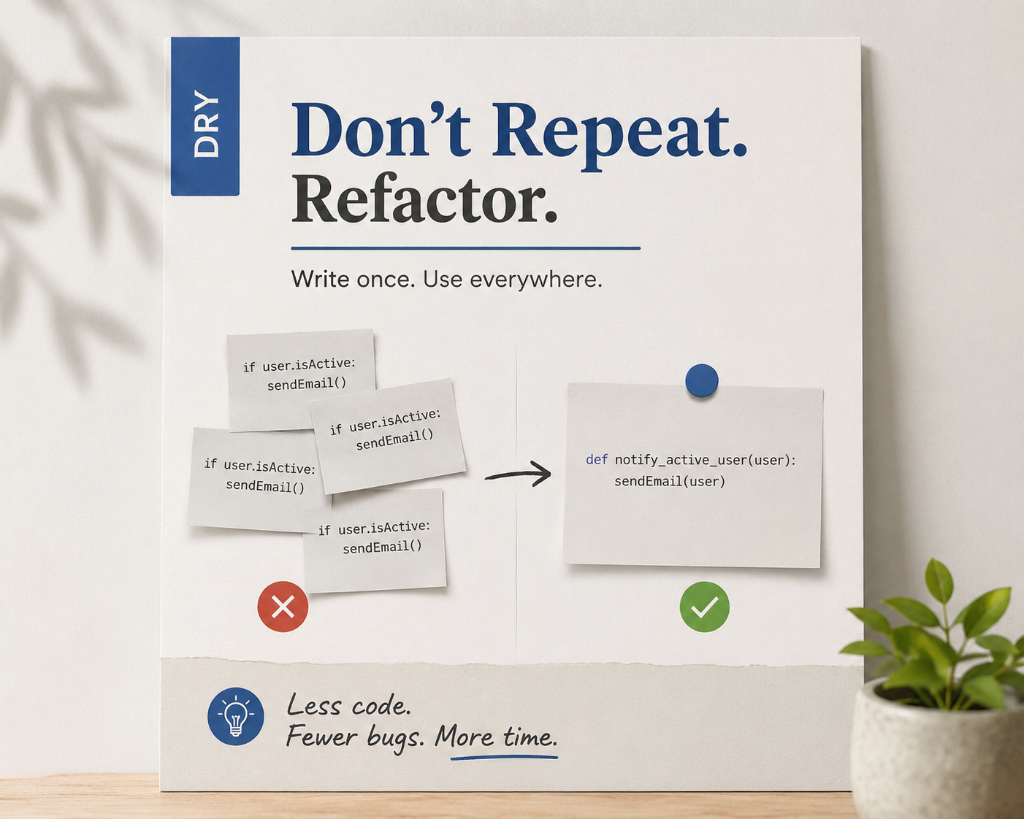
It’s a fascinating realization: the most expensive, time-consuming code debt problem historically created by inexperienced human developers is the exact same problem AI coding assistants generate today.
We call it UN-DRY code.
I’ve been coding for decades, but in February 2026, I stopped writing code entirely. Why? Because in the era of advanced LLMs, manually typing code is a waste of a leader’s time. My role shifted from writing the software to managing the AI that writes it. What I’ve discovered is that managing AI models to build complex systems is identical to managing a team of brilliant but inexperienced junior engineers.
And the biggest hurdle we face is the exact same one you face with human juniors: Copy-Paste-with-Tweaks.
The Most Expensive Code Debt: Enter “UN-DRY” Code
DRY stands for “Don’t Repeat Yourself.” It is the golden rule of software architecture. When code is DRY, a single logic lane handles a specific task. When you need to change that task later, you change it in one place.
When code is UN-DRY (duplicated), it’s a nightmare. An AI—or a junior dev—gets a new feature request, looks at existing code, copies it, pastes it, and changes two lines to make it work for the new scenario.
On the surface, it works. But underneath, it creates a cascade of hidden costs:
- Double code equals double bugs.
- Testing effort triples because you have to verify the same logic across multiple fractured paths.
- When the business logic inevitably changes, the AI (or human) updates one path, forgets the other, and silent, system-breaking regressions creep in.
Recently, while letting an AI autonomously build a new, dynamic process component for our clients’ platform – where the LLM makes real-time decisions in an automated workflow – it generated massive amounts of UN-DRY code. It was creating parallel paths for fallbacks and error handling instead of parametrizing a single, clean function. The testing overhead became unacceptable.
The Solution: Managing AI Like a Senior Engineer
You can’t just yell at an AI (or a junior dev) to “do better.” You have to architect the boundaries. Just as a Senior Engineer enforces coding standards via pull-request reviews, I had to enforce a strict, unyielding mandate.
That’s why our AGENTS.md file – the system prompt that governs how our AI operates – now has a new, ironclad rule:
STRICT DRY PRINCIPLE (DON’T REPEAT YOURSELF):
You must strictly adhere to the DRY principle at all times. Before adding a new feature or code block, you must analyze the existing codebase. If you are about to introduce a copy of existing code with only minor changes, STOP. Instead of duplicating, you must parametrize the existing implementation… Remember: duplicated code equals duplicated bugs and doubled maintenance. Never introduce copy-pasted logic. ALWAYS DE-DUPLICATE. ALWAYS ENSURE HIGH CODE QUALITY.
By forcing the AI to analyze the codebase before writing, and explicitly forbidding copy-paste, the AI is forced to think like a Senior Architect. It must extract shared services, parametrize variations, and consolidate logic.
What This Means for the Future of Automation
This level of AI management – teaching a machine to architect cleanly rather than just hack together functional slop – is the unsung requirement of true business automation.
At our company, we sell three things, and this exact experience is why we are uniquely positioned to deliver them:
1. Maximum Automation
We don’t just use AI to write snippets; we use it to autonomously manage and execute dynamic processes. But Maximum Automation is only valuable if it doesn’t collapse under its own technical debt. By managing the AI to write clean, DRY, enterprise-grade code, we deliver automated systems that are actually maintainable, scalable, and reliable.
2. Private AI
Public LLMs are great for drafting emails, but running autonomous, dynamic processes that make decisions for your business requires strict data hygiene. We implement Private AI solutions, ensuring your proprietary logic, customer data, and internal workflows never leave your infrastructure.
3. Decentralized Systems
When you combine Maximum Automation with Private AI, you need an infrastructure that won’t fail when one node goes down. We applied our expertise in Decentralized Systems for a decentralized marketplace client in the US. We will ensure, your AI-driven workflows are resilient, distributed, and immune to single points of failure.
Stop Coding. Start Managing.
The era of the human “coder” is ending. The future belongs to the AI Manager – the leader who knows how to set boundaries, enforce architecture rules, and guide LLMs to build systems that actually last.
If you’re tired of managing human technical debt, or if you want to see how Maximum Automation, powered by Private AI and Decentralized Systems, can transform your operational overhead, it’s time to talk.
[Contact us today to see our AI-managed automation in action.]