
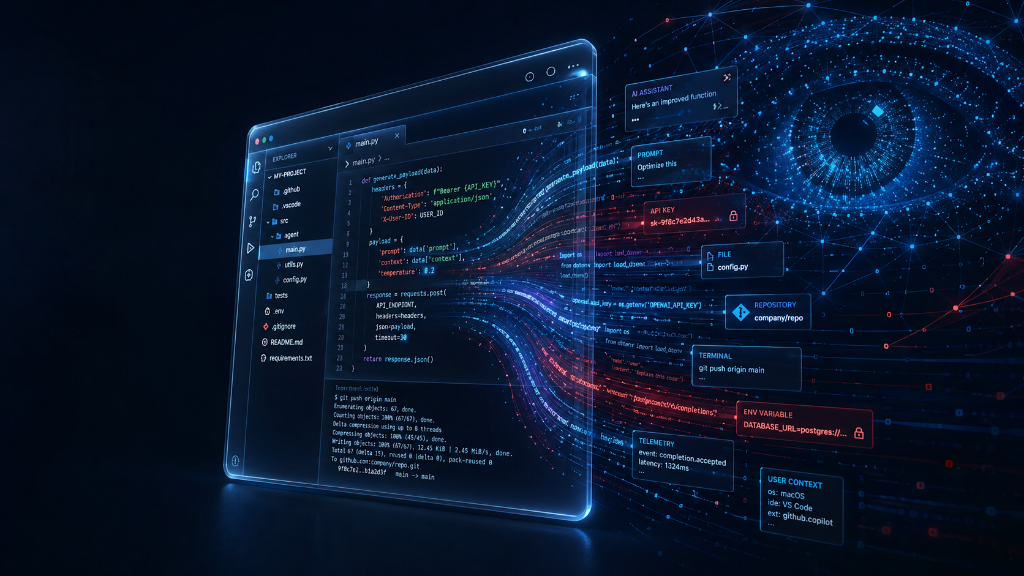
The inconvenient truth about “free” AI tools
Every time a developer pastes source code into ChatGPT, Claude, Gemini, or Grok, that conversation has value. Not just to the developer. To the company building the AI.
Closed-source AI companies have one critical asset: training data for their next model. Every prompt, every code snippet, every architecture discussion you feed them improves the product they sell back to you — and to your competitors.
This is not a conspiracy theory. It is their business model. The incentive is perfectly aligned: log everything, train on everything, get better, charge more. The terms of service may say they don’t train on API inputs (for paying customers), but the free tiers, the consumer products, the “just paste it here” workflows? That data flows somewhere, and the somewhere is always toward making their next model stronger.
If you are a software company with proprietary code, client repositories, or confidential architecture, this should make you uncomfortable. Not because these companies are evil. Because their incentive structure makes logging rational.
The open-source difference: no incentive to log
Open-source models like Qwen, DeepSeek, or Llama are different in one crucial way: nobody owns them exclusively.
When you run an open-source model on a rented GPU — a RunPod instance, a customer-controlled pod — the entity providing the compute has no business reason to log your traffic. They are selling GPU hours, not building the next GPT. Their revenue comes from compute, not from training data.
This is incentive alignment in your favor:
- Closed-source AI providers log because training data is their competitive moat. Every interaction makes their proprietary model better.
- GPU hosting providers have no model to train. They sell compute by the hour. Your code is not their product.
For a business owner evaluating risk, this distinction matters more than any privacy policy. Policies change. Incentives endure.
The practical problem: developers will use AI anyway
You can write policies forbidding public AI tool usage. Most teams have. The problem is enforcement.
Developers are productive with AI assistance. They will find ways to use it. The question is not whether your team uses AI coding tools. The question is whether your proprietary code ends up in the training pipeline of a company that sells AI to everyone — including companies that compete with you.
What a private AI coding setup actually looks like
A private AI coding assistant is not a research project. It is a practical installation:
- Developer works locally using a standard coding assistant tool
- Requests route through a private mesh network — no public HTTP exposure
- The model runs on customer-controlled GPU infrastructure — your server or your rented GPU pod account
- Open-source models process your code — no proprietary model owner on the other end
- Codebase and documentation are indexed privately — the assistant searches your actual code, not generic training data
The result: your developers get AI coding help. Your source code does not flow through systems owned by companies whose business model depends on absorbing it.
Why localhost is not enough
Running a small model on a laptop is private. It is also limited.
Laptop hardware constrains model size, context length, response speed, and codebase understanding. For small tasks, local models work. For understanding a 200,000-line codebase, refactoring across dozens of files, or onboarding new developers onto legacy architecture, you need more GPU power than a MacBook provides.
A private GPU route gives you the model quality of a serious setup without the data exposure of a public API. You rent the compute. You control the network. You choose the model.
The security argument that actually convinces
Privacy policies say “we don’t log.” Incentive structures say “we have every reason to log.”
Which one do you trust with your proprietary code?
- ChatGPT, Claude, Gemini, Grok: Their next model needs to be better than their current model. Your code and conversation feedback helps. The incentive to log is structural.
- Your private GPU running Qwen: Nobody is building a proprietary model from your traffic. The GPU provider sells compute. The model is already open. Your code stays yours.
This is not about paranoia. It is about understanding who benefits from your data and choosing a path where the incentives align with your interests.
What our starter installation for Private AI includes
For software teams that need AI coding help without public source-code uploads:
Private AI Coding Assistant Starter Installation — from EUR 2,000
- One bounded codebase or repository group
- Private model route through customer-controlled infrastructure
- Private codebase and documentation index
- Local developer assistant with private network connection
- Redacted web-search path
- Developer handover session and operating notes
Timeline: 5–7 working days after access is confirmed.
No production credentials required. Read-only code access by default. NDA available.
Who this is for
- Small software companies with 3–30 developers and proprietary code
- Technical agencies handling confidential client repositories
- SaaS companies where source code is a competitive asset
- Teams using legacy stacks where generic AI models are weak
- Founders and CTOs who have already questioned whether public AI tools are safe for their codebase
Who this is not for
- Teams that are comfortable sending all code to public AI providers
- Companies with no developers
- Buyers expecting a perfect Claude/GPT replacement on day one
- Organizations that need enterprise procurement cycles
The first step
If your team wants AI coding help but your code, client contracts, or IP policy make public AI tools unacceptable, the next step is a 20-minute fit call.
We check your code privacy constraints, current developer workflow, preferred infrastructure path, and whether a starter installation is realistic for your codebase.